
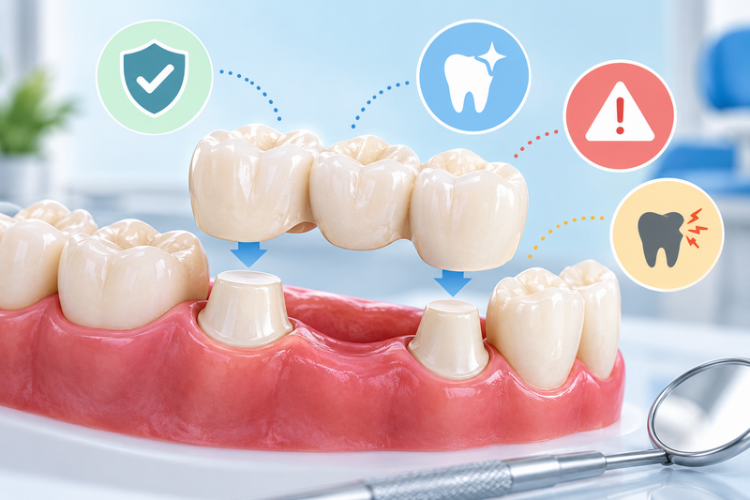
Yes, dental bridges are safe for most adults. They are one of the oldest and most trusted ways to replace missing teeth, and dentists across the United States place them every day.
Still, “safe” does not mean “risk-free.” A bridge depends on the teeth and gums around it, so the result is only as healthy as its foundation. Knowing the benefits, the possible side effects, and how to care for a bridge helps you decide with confidence.
This guide covers each of those points in plain language, so you know what to ask at your next dental visit.
What Is a Dental Bridge?
A dental bridge is a fixed restoration that fills the gap left by one or more missing teeth. It uses a false tooth, called a pontic, held in place by the teeth or implants on either side of the gap.
Unlike a removable denture, a bridge is cemented in place. You brush it, chew with it, and sleep with it, just like a natural tooth.
Common Types of Dental Bridges
- Traditional bridge: Dental crowns on the teeth beside the gap support the false tooth. This is the most common type.
- Cantilever bridge: The false tooth is supported from one side only. It suits areas with lighter bite pressure.
- Maryland bridge: A thin wing is bonded to the back of the neighboring teeth, so very little enamel is removed.
- Implant-supported bridge: Dental implants anchor the bridge instead of natural teeth.
Your dentist recommends a type based on where the gap is, how healthy the nearby teeth are, and your budget. Our guide to dental crowns and bridges in Las Vegas explains cost and procedure in more detail.
Benefits of Dental Bridges
A missing tooth affects more than your smile. The teeth around the gap can drift, your bite can change, and chewing becomes uneven. A bridge addresses those problems in a few practical ways:
- Restores chewing and speech. You can eat a wider range of foods and pronounce words clearly again.
- Keeps neighboring teeth in place. Filling the gap stops nearby teeth from tilting or shifting.
- Looks natural. Porcelain and zirconia are matched to the shade of your own teeth.
- No surgery for most types. Traditional, cantilever, and Maryland bridges need no surgical procedure.
- Faster than implants. Most bridges are finished in two visits over a few weeks.
- Often lower upfront cost. A bridge usually costs less at the start than a single implant, and many dental plans cover part of it.
- Spreads bite forces. Replacing the tooth takes extra pressure off the remaining teeth.
For many patients, the biggest benefit is simple: eating and smiling without thinking about the gap.
Risks and Side Effects of Dental Bridges
Most bridge problems are minor, and most are preventable. They fall into two groups: short-term side effects after placement and longer-term risks that build up over years.
Short-Term Side Effects
These usually ease within a few days to two weeks:
- Sensitivity to hot, cold, or sweet foods in the supporting teeth
- Mild gum soreness around the new bridge
- A bite that feels “off” until your dentist makes a small adjustment
- A brief change in speech while your tongue gets used to the new shape
Long-Term Risks
| Risk | Why it happens | How to lower it |
| Decay in the supporting teeth | Plaque collects where the crown meets the tooth | Brush twice a day and clean under the bridge daily |
| Gum disease | Food and bacteria get trapped beneath the false tooth | Use floss threaders or a water flosser; keep regular cleanings |
| Nerve irritation | Reshaping a tooth can inflame the nerve; a few teeth later need a root canal | Report pain that lingers beyond two weeks |
| Loose or broken bridge | Cement wears out, or the bridge takes heavy force | Avoid chewing ice and hard candy; wear a night guard if you grind |
| Bone loss under the gap | A bridge has no root to stimulate the jawbone | Ask whether an implant-supported bridge suits you |
One more point is a trade-off more than a risk. A traditional bridge requires removing some healthy enamel from the supporting teeth, and that step cannot be reversed.
Allergic reactions to bridge materials are rare. If you have a known metal allergy, tell your dentist, since all-ceramic and zirconia options are available.
When to Call Your Dentist
- Pain or sensitivity that lasts longer than two weeks
- A bridge that feels loose or moves when you chew
- Red, swollen, or bleeding gums around the bridge
- A bad taste or odor that brushing does not fix
Early gum disease treatment can often save both the bridge and the teeth holding it.
Who Is a Good Candidate for a Bridge?
A bridge is safest when its foundation is healthy. You are likely a good candidate if you:
- Are missing one to three teeth in a row
- Have strong, healthy teeth on both sides of the gap
- Have healthy gums with no untreated gum disease
- Are willing to clean under the bridge every day
A bridge may not be the best choice if the neighboring teeth are weak, badly decayed, or loose. In that case, your dentist may suggest treating those teeth first or choosing another option.
How to Keep Your Dental Bridge Safe and Long-Lasting
Daily care is the biggest factor in how long a bridge lasts. With good habits, many bridges last 10 to 15 years, and some last longer.
- Brush twice a day with a soft-bristle brush and fluoride toothpaste.
- Clean under the bridge daily with a floss threader, interdental brush, or water flosser.
- Skip the hard stuff. Ice, hard candy, and popcorn kernels can crack porcelain.
- Protect against grinding. A custom night guard shields the bridge while you sleep.
- Keep your checkups. Regular dental exams catch small problems before they threaten the bridge.
For a closer look at lifespan and warning signs, read How Long Do Dental Bridges Last?
Alternatives to a Dental Bridge
A bridge is one of several good options. The right one depends on your mouth, your timeline, and your budget.
- Dental implants replace the tooth root, help preserve jawbone, and leave neighboring teeth untouched. They cost more upfront and take longer. See our comparison of dental implants vs dental bridges.
- Dental implants replace the tooth root, help preserve jawbone, and leave neighboring teeth untouched. They cost more upfront and take longer. See our comparison of dental implants vs dental bridges.
- Partial dentures are removable and budget-friendly, and they can replace several teeth at once. Learn more about dentures in Las Vegas.
- All-on-4 implants suit patients missing most or all teeth in an arch. Read about All-on-4 dental implants.
Frequently Asked Questions
Is getting a dental bridge painful?
No. Your dentist numbs the area with local anesthetic, so you feel pressure but not pain. Mild soreness or sensitivity afterward is normal and usually fades within a few days.
Can a dental bridge damage the teeth next to it?
It can if plaque builds up around the supporting teeth. Decay under the crowns is the most common reason bridges fail. Daily cleaning under the bridge and regular checkups keep that risk low.
How long does a dental bridge last?
Most last 10 to 15 years with good care. Location in the mouth, material, grinding habits, and oral hygiene all affect lifespan.
Can food get stuck under a dental bridge?
Yes, small bits of food can collect beneath the false tooth. A floss threader or water flosser removes them in under a minute. Frequent trapping can mean the fit has changed, so mention it to your dentist.
Is a dental bridge better than an implant?
Neither is better for everyone. A bridge is faster, needs no surgery, and costs less upfront. An implant protects jawbone and leaves nearby teeth alone. Your dentist can compare both for your situation.
Does dental insurance cover a bridge?
Many plans cover part of the cost because a bridge is a restorative treatment. Coverage varies, so check your plan or ask our office to review your benefits.
Ready to Restore Your Smile? Explore Your Options
Dental bridges are a safe, proven way to replace missing teeth when the supporting teeth and gums are healthy. Most side effects are mild and short-lived, and the main long-term risks come down to cleaning and checkups.
If you are weighing your options, a personal exam is the best next step. Comfy Dental Care has served Las Vegas families for more than 38 years, and Dr. Kevin Khorshid and his team will walk you through every choice.
Explore our dental bridges in Las Vegas, schedule a dental consultation, or contact our office at (702) 869-8200. We are located at 803 S 7th St, Las Vegas, NV 89101.

phjl16app
Coming from the Philippines I can honestly say this is one of the best places I have found for a hassle free gaming experience. Deposits through local banks work perfectly and I usually get my winnings within hours. The interface is very easy to navigate even for beginners like me. phjl16app