
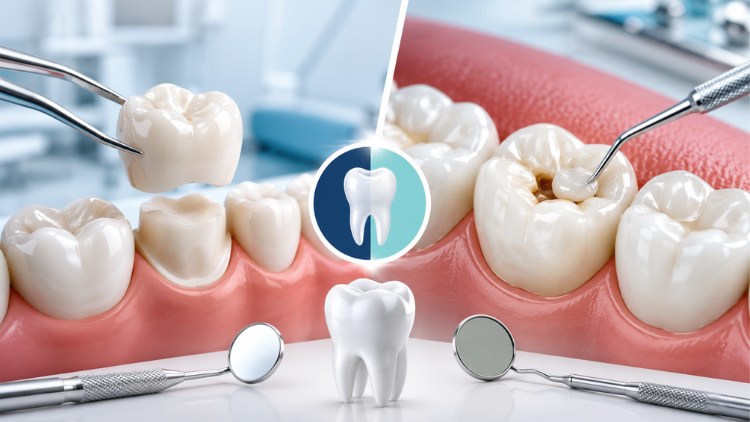
You’re sitting in the dental chair and your dentist says the words you’ve been dreading: “You have a cavity” — or maybe something worse, like a cracked or severely damaged tooth. What comes next is a decision that confuses a lot of patients: do you need a filling, or do you need a crown?
Both treatments restore damaged teeth and protect them from further harm. But they’re not interchangeable. The right choice depends on how much of your tooth is affected, where the damage is located, and what your long-term dental health goals look like. This guide breaks it all down clearly so you can walk into your next appointment informed and confident.
What Is a Dental Filling?
A dental filling is one of the most common dental procedures in the United States. It’s used to repair a tooth that has been damaged by decay (a cavity) or minor fractures. The dentist removes the decayed portion of the tooth, cleans the area, and fills the cavity with a material — typically composite resin (tooth-colored), amalgam (silver), or glass ionomer.
Fillings are a conservative treatment. They work from the inside of the tooth outward, preserving as much of your natural tooth structure as possible. Most fillings can be completed in a single appointment and require very little recovery time. Patients are typically back to normal eating and drinking within a few hours.
At Comfy Dental Care, Dr. Kevin Khorshid offers modern dental fillings that restore tooth function while blending naturally with your smile — a far cry from the visible metal fillings of decades past.
What Is a Dental Crown?
A dental crown is a custom-made cap that fits over the entire visible portion of a tooth, from the gum line up. It encases the tooth completely, restoring its shape, size, strength, and appearance. Crowns are made from durable materials like porcelain, ceramic, metal, or a combination of these.
Unlike a filling, which fills a void within the tooth, a crown wraps around the outside of it. This makes crowns especially valuable when a tooth has been significantly damaged, weakened, or compromised — situations where a filling alone wouldn’t provide enough structural support.
Crowns are also used in combination with other treatments. They cap teeth that have had root canals, they anchor dental bridges, and they cover dental implants to create a complete, natural-looking restoration.
Getting a crown at Comfy Dental Care typically takes one to two appointments. Using advanced 3D digital scanning technology, Dr. Kevin creates precise, custom-fit crowns that match your natural tooth color and dimensions — no guesswork, no ill-fitting caps.
Key Differences: Crowns vs. Fillings at a Glance
| Factor | Dental Filling | Dental Crown |
| Best for | Small to moderate cavities, minor chips | Large cavities, cracked/broken teeth, root canal-treated teeth |
| Coverage | Fills a void inside the tooth | Covers the entire visible tooth |
| Tooth structure removed | Minimal | More (to make room for the crown) |
| Appointments needed | Usually one | Typically two |
| Lifespan | 5–15 years (varies by material) | 10–20+ years with proper care |
| Cost | Lower | Higher |
| Strength added | Moderate | Significant |
When Is a Filling the Right Choice?
Fillings work best when the damage to a tooth is limited and the remaining tooth structure is strong enough to support the restoration. A filling is typically recommended when:
- The cavity is small to medium in size
- The decay hasn’t reached the inner pulp of the tooth (the nerve)
- The tooth hasn’t cracked or fractured under pressure
- The structural integrity of the tooth is largely intact
- A cosmetic issue like a minor chip or worn edge needs correction
If you’ve been attending your dental exams regularly, your dentist is more likely to catch cavities early — when a simple filling is all that’s needed. This is one of the biggest reasons routine check-ups matter so much. Catching a small cavity today prevents a much bigger (and more expensive) problem tomorrow.
When Is a Crown the Right Choice?
A dental crown becomes necessary when a tooth is too damaged, weakened, or structurally compromised for a filling to do the job adequately. Common scenarios where a crown is the better option include:
- Large cavities that have destroyed more than half the tooth’s surface area
- Cracked or broken teeth, especially cracks that extend below the gum line
- Teeth that have undergone a root canal, which leaves the tooth more brittle and prone to fracture
- Severely worn teeth from grinding (bruxism) or acid erosion
- Cosmetic restoration of a misshapen, heavily stained, or structurally weak tooth
- Anchoring a dental bridge to replace a missing tooth
If a cavity is left untreated for too long, what could have been a straightforward filling often escalates into the need for a crown — or even extraction. This is why timely dental consultations and regular exams are so important. The sooner a problem is identified, the simpler the solution tends to be.
What About Dental Bonding?
There’s actually a third option worth mentioning for mild cosmetic or structural concerns: dental bonding. Bonding uses a tooth-colored resin applied directly to the surface of a tooth to repair minor chips, cracks, gaps, and discoloration. It’s faster and more affordable than a crown, and requires little to no removal of tooth enamel.
However, bonding is best suited for minor cosmetic issues on otherwise healthy teeth. For more extensive damage or structural problems, a crown remains the more durable and appropriate choice. Curious about how bonding compares in detail? The Comfy Dental blog post Dental Bonding Before and After: What to Expect at Every Stage walks through the process comprehensively.
Can a Filling Be Upgraded to a Crown Later?
Yes — and this is actually fairly common. Sometimes a dentist places a filling to manage decay, but over time the filling cracks, the surrounding tooth weakens, or new decay develops around the edges of the filling. When that happens, a crown may become the better long-term solution.
This is also why the quality and depth of a filling matters. A properly placed, well-maintained filling can last many years. But if a tooth has already had several fillings, or if the existing filling is large, your dentist may recommend going straight to a crown to avoid repeated treatment down the road.
Get the Right Treatment for Your Smile
Whether you need a simple filling or a full dental crown, the most important step is getting a professional evaluation before the problem worsens. At Comfy Dental Care in Downtown Las Vegas, Dr. Kevin Khorshid and his experienced team take the time to examine your tooth thoroughly, explain your options clearly, and recommend the treatment that genuinely fits your situation — not a one-size-fits-all approach.Book Your Appointment Today — and take the guesswork out of your dental care.
Frequently Asked Questions
Q: How do I know if I need a filling or a crown?
Your dentist will determine this based on the size and severity of the damage, where the tooth is located, and the overall structural health of the tooth. An X-ray is often the deciding tool — it shows how deep the decay goes and whether the inner structure of the tooth is still sound. The best way to find out is through a professional dental exam at Comfy Dental Care.
Q: Are dental crowns painful?
The procedure itself is performed under local anesthesia, so you shouldn’t feel anything during the appointment. Some sensitivity in the days following is normal, particularly to hot and cold temperatures, and it usually resolves on its own within a week or two.
Q: How long does a dental filling last?
It depends on the material. Composite resin (tooth-colored) fillings typically last 5 to 10 years. Amalgam fillings can last 10 to 15 years or longer. Regular dental visits allow your dentist to monitor the condition of your fillings and catch any issues before they become larger problems.
Q: Do crowns look natural?
Modern porcelain and ceramic crowns are matched precisely to the color, shape, and size of your surrounding teeth. With digital imaging and 3D scanning technology, the fit and aesthetics are extremely accurate. Most patients find their crown indistinguishable from a natural tooth.
Q: Is it possible to avoid a crown if I act quickly on a cavity?
In many cases, yes. Small cavities caught early can almost always be treated with a simple filling. The longer decay goes untreated, the more tooth structure is lost — and once too much of the tooth is compromised, a crown becomes unavoidable. This is the single best argument for attending regular dental check-ups.
Q: What other treatments might I need alongside a crown or filling?
Depending on your situation, your dentist may recommend a root canal before placing a crown if the decay has reached the inner pulp. In cases of missing teeth, a crown often works in tandem with a bridge or implant. If you’re exploring options for missing teeth, the dental services page at Comfy Dental Care is a great place to start.